(A Lithuanian daily looks into security officer's "mysterious" death--
Excerpt from report by Lithuanian newspaper Kauno Diena; article by Raimundas Celencevicius and Lauryna Vireliunaite: "Prosecutors Did Not Even Consider the Version of Pociunas's Death That Is Becoming the Most Important Version")
During early morning hours of 23 August 2006 in the Belarusian city of Brest, Vytautas Pociunas, a senior State Security Department [VSD] officer, fell from the ninth-floor hotel window. He died instantly. On 30 November 2006, the Prosecutor General's Office closed the case on Pociunas's death after determining that it was an accident.
On 26 June, Pociunas's widow, Liudvika Pociuniene, demanded the reopening of the investigation because she has a reasonable suspicion that her husband was murdered. It turned out that prosecutors did not even consider this version: Pociunas might have been killed by a group that is trying to assume control of Lithuania.
Pociunas's death had a snowball effect: It tore up the VSD, forced VSD Director Arvydas Pocius out of office, and revealed that Lithuanian special services and state leaders may be mere puppets and that, in reality, the country is ruled by players who remain in the shadows and who are closely tied to Russia's business and political elite.
All Versions Ruled Out
Pociunas's death received a lot of attention at the end of last summer. The Conservatives [Homeland Union; TS], with whom Pociunas was closely linked during the last years of his life, devoted the biggest amount of attention to this incident. Euro MP Vytautas Landsbergis, a former leader of the Conservatives, openly said Pociunas's death was premeditated.
Landsbergis said the theory that labelled Pociunas's death as completely unconvincing. Thus, the only alternative left -- murder. "And of course, it was a political murder," the Euro MP said openly, implying that the Belarusian special services might have been involved in this crime.
The theory that Pociunas was killed by Belarusian special services, which was debated by the Lithuania media for some time, was quickly forgotten, because there was no evidence to support it.
Pociunas, who occupied a senior post in the VSD, had a much more humble post in Belarus - he was responsible for protecting information at the Lithuanian consulate in Hrodna. The officer used to complain to his close friends that he was often performing simple maintenance duties. It is very unlikely that the Lithuanian officer who was involved in such activities might have angered the Belarusian special services to the point that they decided to kill him.
Most Important Theory Not Even Considered
After ruling out all of the above theories and not finding any signs of struggle in Pociunas's hotel room, prosecutors decided that Pociunas's death was an accident. Yet, to many it is still hard to understand why a mature, educated man would lean so far over the window ledge that he fell out, despite the fact that he was a little intoxicated.
Newly discovered facts allow one to think that the officer's death might have been useful to some of his colleagues and certain Lithuanian politicians and businessmen tied to those colleagues. There is a frightening coincidence: These days it has become known that on 30 March of this year, the VSD gave a Second Degree Merit Cross to Justas Laucius, the prosecutor who determined that Pociunas's death was an accident. VSD Press Secretary Vytautas Makauskas tried to convince the media that Laucius was honoured for prosecuting Vilius Karalius, the so-called king of contraband, and three court chairmen connected to him. This explanation raises many suspicions, because those cases reached the court in 2004, and Laucius was given the award only now, after he ruled that Pociunas's death was an accident, not murder.
On 29 June, Kauno Diena found out that the Prosecutor General's Office did not even consider the version that Pociunas might have been murdered, because even after having been exiled to Hrodna, he had continued to collect information about a certain group that was trying assume control of Lithuania and had been planning to reveal that information. This theory is now becoming the most important explanation of his death.
On 29 June, Deputy Prosecutor General Gintaras Jasaitis told Kauno Diena that the main task of the investigation was to find out whether a crime was committed. "Various circumstances of the death were investigated. The Seimas [parliament] committee asked us whether we intend to investigate the circumstances surrounding Pociunas's transfer. We answered that it was not an objective of our investigation. Of course, if we had received any signs that the transfer was unlawful, criminal, we would have investigated it. Yet, we were unable to investigate that, because there were no signs of criminal activity," Jasaitis said.
The Seimas National Security and Defence Committee, which was investigating the VSD activities for several months, established that Albinas Januska, current aide to Prime Minister Gediminas Kirkilas and former national security adviser to President Valdas Adamkus, had a huge influence on the VSD leadership. It was also established that Januska had very close ties to the energy company Dujotekana [Gazprom intermediary] and company president Rimandas Stonys, whose wide connections extend to Russia's business and political elite. VSD officers testified they had collected plenty of information proving that by generously financing political parties and the media, Dujotekana was exercising huge unlawful influence on the country's political and economic life and that Januska and Stonys discussed appointments of senior political officials. VSD officers testified they were ready to declare Dujotekana a cover company for the Russian special services, but the VSD leaders blocked their plans.
Deadly Candidness
This week during the Lithuanian National Radio show "Between East and West," Pociunas's former friend and co-worker Kestutis Masiulis, leader of the Conservatives Party's Vilnius branch, announced that two years ago his friend told him about the things that were recently revealed by the National Security and Defence Committee, which investigated the VSD activities.
Masiulis said that in August 2005, Pociunas told him that the VSD leadership was planning to fire him. According to Masiulis, already back then his friend said he had stumbled across a large network of people who work against Lithuania and who had influence over the VSD leadership. According to Masiulis, this is why Pociunas became an unwanted troublemaker who had to be transferred somewhere far away. "His words were very hard to believe. The things were so frightening that at first I did not think they were serious and real," Masiulis recalled.
Darius Kuolys, the show's host, quoted two of Pociunas's phone messages that were sent two years ago. On 10 September 2005, Pociunas wrote: "I am being made a scapegoat; I will be buried." On 27 October 2005, he wrote: "I am not crazy. I will try to prove that I did not lose, and I think others will understand."
Masiulis and Pociunas also met during the summer of 2006. "We left our phones, went out into a garden, sat down, and for two hours he told me about horrible things, about control over our state. I realized he was determined enough to stop those things. He was determined, but he looked like a person who was under a lot of pressure and who was pushed into a corner. Even back then, it was difficult for me to accept all that information. It was wide - it touched Itera Lietuva, Stella Vitae - the natural gas companies that were working before Dujotekana. It was about their networks, their influence on the media and politicians. I was surprised by the VSD's total apathy. He spoke about Dujotekana's ties to state officials, the media, and politicians. He spoke about a spider web that entangled Lithuania, that was choking it, and that was trying to destroy it. He did not trust his superiors or the President's Office. He spoke to me as if speaking to a priest during a confession. He was looking for people whom he still trusted and was trying to figure out what to do. He was no longer able to trust his workplace, the most important politicians, while the state was being conquered. What was he to do? What was the officer, who saw such horrible processes and knew that his superiors and perhaps even state leaders were involved, supposed to do? The only possible solution was probably the media. He went to his closest friends, looking for approval. A week went by after our conversation. I went to Germany, and I heard about his death," Masiulis recalled.
His former colleagues and friends testified before the Seimas committee that Pociunas was planning to reveal the information about the web of corrupt politicians, businessmen, and officers that entangled Lithuania in the fall. Pociunas did not live to see the fall. Yet, symbolically, the probe into the VSD activities was launched that autumn, and during that probe the information that was collected about the entanglement of the state began to be revealed to society.
What Was VSD Leadership Afraid Of?
If the things that Masiulis and Pociunas's former colleagues are saying are true, his transfer to Hrodna becomes logical, and a key to solving his mysterious death appears. The fact that two years ago Pociunas uncovered shadowy ties between the VSD leadership, senior politicians, and influential businessmen who are tied to Russia seems to be more a convincing reason why Pociunas was transferred from the VSD to the foreign country than the idea being pushed by the VSD leadership, that Pociunas decided to leave due to personal conflicts with his colleagues. Moreover, after Pociunas's transfer, the division that he had headed was shut down, and the leaders of the counterintelligence division who continued his investigations were expelled.
The VSD leadership's attempts to kill the investigation into Pociunas's death become understandable, too. After losing his composure, Darius Jurgelevicius, a deputy VSD director, told the media and politicians to "stop digging among the bones," because very unpleasant things might be uncovered. VSD Director Pocius, directly and through intermediaries, pressured the Conservatives not to initiate the probe into Pociunas's death and was trying to force the VSD counterintelligence directors not to testify before the Seimas committee. After the attempts to extinguish the probe failed, the VSD used media loyal to the department to spread compromising information about Pociunas. Society was told that Pociunas allegedly was drunk and fell out the window while trying to urinate. It was also said that Pociunas, who until that moment was considered an almost ideal family man, had a mistress - a journalist who was constantly visiting him in Hrodna - and allegedly Pociunas's wife had a relationship with her co-worker.
Source: Kauno Diena, Kaunas, in Lithuanian 30 Jun 07
BBC Mon EU1 EUOSC vk
Thursday, July 05, 2007

Monday, June 25, 2007
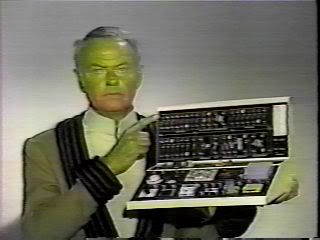
ONTV in Chicago
ONTV was the first paid subscription "cable" television we had on the South side of Chicago in the early '80s. This logo is burned on my brain as it was the signifier of a treasure trove of "adult" movies such as "Ellie" starring Shelley Winters and Cheech and Chong's "Up In Smoke". My brother and I would perch on lemon-yellow velour couch cushions, construct Millenium Falcon "forts" and pop up Orville Reddenbacher popping corn to absorb the golden era of new entertainment made available to us via the ONTV gateway and of course, our brand new Betamax player.
Tuesday, June 12, 2007
The Toni Perm

I'll never forget the first Toni perm. 6th grade boyfriend from the public pool. It lasted 4 days (the relationship and the perm), he gave me a stuffed animal from Great America. His cousin came over and she screeched--"O MI GOD! THAT'S MY STUFFED ANIMAL!"
Used stuffed animal. Sun-In and Toni. DO NOT USE ON LADY BUSINESS AND JUMP IN CHLORINATED POOL--neighborhood skank did this and relayed her tale of woe.
Monday, June 11, 2007
Ryokan

Like Han-shan in China, Ryokan is loved in Japan as much for his antics as for his profound poetry.
Ryokan became a priest at age 18 and took to a life of wandering. He eventually met his teacher, Kokusen Roshi, and settled down to study Zen practice, ultimately becoming his most esteemed student. When Kokusen Roshi died, Ryokan inherited his temple. But the duties and regularity of being temple master didn't suit Ryokan, and he resumed his itinerant life.
He next settled in a small hut he called Gogo-an on Mt. Kugami, where he lived by begging.
Ryokan's love of children and animals are legendary. He often played games with the local children, attested to in his own poetry.
His reputation for gentleness carried sometimes to comical extremes. One tale is told that, one day when Ryokan returned to his hut he discovered a robber who had broken in and was in the process of stealing the impoverished monk's few possessions. In the thief's haste to leave, he left behind a cushion. Ryokan grabbed the cushion and ran after the thief to give it to him. This event prompted Ryokan to compose one of his best known poems:
The thief left it behind:
the moon
at my window.
When Ryokan was 70 and nearing the end of his life, he met a young nun and poet named Teishin. Though Teishin was only 28, they fell in love. They exchanged several beautiful love poems.
As Ryokan was dying, Teishin came to him and held him at his moment of death. It was Teishin who collected and published Ryokan's poetry after his death.
Friday, June 08, 2007

Thursday, May 10, 2007
Free Sample

Sample supermarket maven
veteran of persuasion!
Her secret life,
series of bloody,
unrelenting moments of horror
There is an unspoken code among those who make a profession of the supermarket sample gig. They are the seasoned experts at creating a moment of enticement--appealing to senses of smell and taste, one spear of toothpick precision to your very core. They are seductress and alchemist: tempting with timing. Ah, the banal shopper will be enticed yet! Come, gather 'round the card table: Jimmy Dean sausage, you say? A coupon, you say? They are themselves delectables to be savored with great fervor, then ignored. They are masters of detachment, knowing their sisters of the streets well. Never, never get emotionally involved. It's just a job.
Saturday, May 05, 2007
Yakov's Lines That Kill/Un Wodka Un Vine

"America: What a country!"
- I misunderstanding of American life and custom through the eyes of a new immigrant. For instance, reading employment announcements of "Part-Time Woman Wanted": What a country! Even transvestites can get work!
- I was offered a position as a barman on a "graveyard shift". A bar in a cemetery! What a country! Last call? During Happy Hour the place must be dead.
- At the grocery store: Powdered milk, powdered eggs, baby powder . . . what a country!
- The first time I went to a restaurant, they asked me 'How many in your party?' and I said "Six hundred million."
- We have no gay people in Russia—there are homosexuals but they are not allowed to be gay about it. The punishment is seven years locked in prison with other men and there is a three-year waiting list for that.
- You have such nice things in the U.S.—like warning shots!
- In the Soviet Union, we have no prostitution. Russian women have trouble giving it away.
- Russian women: At 20, they look 40. At 40, they look 60. At 60—don't look.
- Instead of Disneyland, we have "Dissident Land"--it's so fun there that no one ever leaves!
- "There are no Taco Bells in Russia. They didn't like the slogan, 'Run for the border.'
___________________________________________

Ivan Rebroff: My brother has had this album for years. It is an inspiration to alcoholics everywhere.

Now my own joke: Franzia: It's like Capri Sun for alcoholics! I SLAY MYSELF. Franzia has always been the disgruntled housewife's drink of choice.
Eddie Rabbitt I
Eddie Rabbit performs in Branson, Missouri, a place where Bridget and I will someday see the original Borat, Yakov Shmirnoff.
I wrote a collaborative poem with some friends regarding Mr. Rabbit (later posting). It was a great success, as the disjointed lines we wrote prior to putting the poem together in its purest, oral form, seemed to fittingly and eloquently crystallize the sudden and absurd fascination with Eddie Rabbit that night.
Friday, May 04, 2007
Eric Von Zippah

I've always adored Harvey Lembeck in this role, but thre was always Mother, Juggs, and Speed.
Chukotka Autonomous Okrug

Chukotka Autonomous Okrug (Russian: Чуко́тский автоно́мный о́круг, tr.: Chukotsky avtonomny okrug; Chukchi: Чукоткакэн автономныкэн округ), or Chukotka (Чуко́тка), is a federal subject of Russia (an autonomous okrug) located in the Far Eastern Federal District. It is the farthest northeast region of Russia, and since the sale of Alaska to the United States is the only region of Russia lying partially in the western geographical hemisphere. It is washed by the Bering Sea and the East Siberian Sea. Chukotka has an area of 737,700 km² and population of 53,824 (according to 2002 Census), and just over 55,000 in 2004. The principal town and administrative center is Anadyr.
Chukotka was formerly an autonomous okrug subsumed within Magadan Oblast, but it declared its separation in 1991; a move that was confirmed by the Russian Constitutional Court in 1993.
Elgygytgyn Lake, an important site for scientific research on climate change, is located in Chukotka.
Traditionally the home of the native Chukchi people, Siberian Yupiks, Koryaks, Chuvans, Evens/Lamuts, Yukagirs, and Russian Old Settlers, the region was subject to collectivisation and forced settlement during the Soviet era.
Chukotka has large reserves of oil, natural gas, coal, gold, and tungsten, which are slowly being exploited, but much of the rural population exists on subsistence reindeer herding, hunting, and fishing. The urban population is employed in mining, administration, construction, cultural work, education, medicine, and other occupations.
Chuck E. Sellier, Creator, Bulk of the Series, Not Exactly A Lightweight

Check out this awesome tribute site to Grizzly Adams.
http://www.grizzlyadams.net/
Wednesday, April 25, 2007
The Cows
I like these guys from Minneapolis...wish You Tube had some clips of The Cows playing "El Shiksa". One of my favorites.
Tuesday, April 24, 2007
Poison Arrow
This ABC song came to mind this morning. The Greek tragedy set to 80's synthesizers. Once again, art imitates my life minus all the percussionists (gentleman, is it necessary to have mammoth orchestra bass drums and assorted congas for a song that employs a single Casio SK-1 drum machine?) Anyway, the quick flash of the Coke advertisement at the end is good for sponsorship. Poison and Coke? A winning, refreshing combination!
Thursday, April 19, 2007
Time is Bleeding
In 2006, I wrote a preface for Denis Emorine's book, Au chevets des mots (A Step Inside). I remember reading this little book and becoming quite delighted with it...it spurned my desire to quest for that which is unsaid or cannot be said...that is, the pauses between "words" that say EVERYTHING. (Kalinauskaite, previous entry)
It was liberating to lose myself in this wistful reverie.
Preface: Here is a collection of vignettes that invites the dreamer into the elusive, entrancing perpetual fever of poetry. Here you are in the town square of language, where words elope, make love, fight, and part like unsatisfied, restless lovers into the night. It is never enough, it seems, when it comes to language. There are words that masquerade and manipulate, and there is the purity of meaning, as Emorine seems to suggest from the opening quotation used:
"And then, we'll be able to talk without stumbling into those words that cause time to bleed." --Jo Bousquet.
...The heart of this collection is in the segment "Fever", when Emorine declares: "Only silence has the bedside manner needed to respond to words broken down by their plentitude."
-Lina ramona Vitkauskas
ISBN: 2-919942-15-8
It was liberating to lose myself in this wistful reverie.
Preface: Here is a collection of vignettes that invites the dreamer into the elusive, entrancing perpetual fever of poetry. Here you are in the town square of language, where words elope, make love, fight, and part like unsatisfied, restless lovers into the night. It is never enough, it seems, when it comes to language. There are words that masquerade and manipulate, and there is the purity of meaning, as Emorine seems to suggest from the opening quotation used:
"And then, we'll be able to talk without stumbling into those words that cause time to bleed." --Jo Bousquet.
...The heart of this collection is in the segment "Fever", when Emorine declares: "Only silence has the bedside manner needed to respond to words broken down by their plentitude."
-Lina ramona Vitkauskas
ISBN: 2-919942-15-8
Tuesday, April 17, 2007
Arizona

Carefree, AZ. Cave Creek, AZ. Sedona, AZ. Pure vortexes of energy in those stoic, wise rocks that have stood the test of time on the barren landscape. The vegetation--saguaro cacti, ocatillo, pricky pear. Javelinas cross the roadways. Cowpokes and Harley riders. The stretches of long desert miles. The constellation-filled sky--seeing Venus as bright as the sun.
Thursday, April 05, 2007
Pulpo
“Ace Of Wands
Scissors in a cross
An invisible heart
is distressed, see it?
A heart reflected on the wind.”
—“Incantation”, Poem of the Deep Song, Gabriel Garcia Lorca
The still wave,
pulpo of ice, storm reef,
stolen elephante forms
an apprehensive crash.
Emily said, “A word that
breathes distinctly
has not the power to die.”
The ether of each ovary ember,
lost in the wine of night.
I could juxtapose jurors, virgins
and my twisted tongue
and remain a lamp
that witnessed the stabbing:
"Como tembalaba el farolito de la calle!"
Scissors in a cross
An invisible heart
is distressed, see it?
A heart reflected on the wind.”
—“Incantation”, Poem of the Deep Song, Gabriel Garcia Lorca
The still wave,
pulpo of ice, storm reef,
stolen elephante forms
an apprehensive crash.
Emily said, “A word that
breathes distinctly
has not the power to die.”
The ether of each ovary ember,
lost in the wine of night.
I could juxtapose jurors, virgins
and my twisted tongue
and remain a lamp
that witnessed the stabbing:
"Como tembalaba el farolito de la calle!"
Invisible Hairshirt
Lyrics to 20+ year-old songs like Alison Moyet's "Invisible" (which stopped by the brain this morning) has redressed the idea that the subconscious does have a soundtrack and puts the needle to the proverbial life vinyl when an appropriate "groove" arises.
My whole life, I've seen the world symbolically, through letters/characters, language/words, sounds/sights. It is amazing to me, when I observe waves that crash against rock, that I can process it to the point of feeling, for a moment, as if I am a wave. My reception to nature could further be tuned, but the frequency has at least registered.
Between Moyet, REM, and the torrential and seemingly chilling waves this morning, I recall a conversation last night with a few writers about music's role or importance in finding a voice in writing. The poetic is fictional and fiction is poetic and reality is only word in the language that should always be used in quotes.
-----------------------------------------------------
"So here I am. Here I am."
I am not the type of dog
That could keep you waiting
For no good reason
Run a carbon-black test on my jaw
And you will find it's all been said before
I can swing my megaphone and long arm the rest
It's easier and better
To dispute it from the chest
Of desire
I could walk into this room
And the waves of conversation are enough
To knock you down in the undertow
So alone, so alone in my life
Feed me banks of light
And hang your hairshirt on the lowest rung
It's a beautiful life
And I can hang my hairshirt
Away up high in the attic of the wrong dog's life chest
Or bury it at sea
All my life I've searched for this
Here I am, here I am in your life
It's a beautiful life
My life
It's a beautiful life
Your life
My whole life, I've seen the world symbolically, through letters/characters, language/words, sounds/sights. It is amazing to me, when I observe waves that crash against rock, that I can process it to the point of feeling, for a moment, as if I am a wave. My reception to nature could further be tuned, but the frequency has at least registered.
Between Moyet, REM, and the torrential and seemingly chilling waves this morning, I recall a conversation last night with a few writers about music's role or importance in finding a voice in writing. The poetic is fictional and fiction is poetic and reality is only word in the language that should always be used in quotes.
-----------------------------------------------------
"So here I am. Here I am."
I am not the type of dog
That could keep you waiting
For no good reason
Run a carbon-black test on my jaw
And you will find it's all been said before
I can swing my megaphone and long arm the rest
It's easier and better
To dispute it from the chest
Of desire
I could walk into this room
And the waves of conversation are enough
To knock you down in the undertow
So alone, so alone in my life
Feed me banks of light
And hang your hairshirt on the lowest rung
It's a beautiful life
And I can hang my hairshirt
Away up high in the attic of the wrong dog's life chest
Or bury it at sea
All my life I've searched for this
Here I am, here I am in your life
It's a beautiful life
My life
It's a beautiful life
Your life
Tuesday, April 03, 2007
Le Notti Bianche (1957), Visconti

Le notti bianche (White Nights), directed by Italian neorealist Luchino Visconti, takes its title and basic plot from Fyodor Dostoevsky’s 1848 short story. In both the story and the film, a lonely young man meets a lonely young woman.
Mario (Marcello Mastroianni) is lonely for social reasons; he is a stranger and a newcomer to town. Natalia (Maria Schell) is lonely because she has always lived in isolation, even in the heart of the city. Her loneliness is intensified because she is in love with a man (Jean Marais) who may not ever return to her, but who continues to occupy her heart to the exclusion of any other possible relationship.
Mario thanks the young woman for the moment of happiness she has brought him. However, he is left alone at the end of the film, befriending the same stray dog he met at the beginning. He is back at square one, and has put more energy into pursuing the fantasy of an obsession rather than any prospect of real love.
Subscribe to:
Posts (Atom)