Monday, October 27, 2008

Algebra Suicide


Enjoy Lydia Tomkiw, belle of Chicago's disjointed poetic collaboration, Algebra Suicide. How true and tragic these turns:

"It's was keeps our glands oiling."

I was also given (to borrow) Joe Soap's Canoe from the UK (Copyright 1991) which included essays on poems that poets were assigned. Citics/essayists included Paul Violi, Tony Towle, and Simon Pettet, among others.

Thursday, October 09, 2008

"The Fall"


A visually stunning movie about a beautiful little Persian girl with a wild imagination who worked in the citrus groves of California in 1913, and who is in a sanotorium/hospital after falling and breaking her arm. She meets a young suicidal actor who tells her tall tales while they are both in the hospital. The director is Tarsem, helped with producers Spike Jonze and David Fincher.

An absolutely captivating spectacle of scenery and two great lead actors who make this story of the human condition and connection resonate. Some nods to Fellini and Jordorowsky.

Wednesday, July 09, 2008

Daumal & Soyinka


I tend to tag-team read, that is, I read about 3-4 books at a time. This past week, every morning on the train, I've cracked open the Rene Daumal book, Le Contre-Ciel (The Counter-Heaven) that Simone bought me for my birthday. Daumal is a self-destructive 22-year old at this point, one who is raging with life questions, specifically how to bring about the realization of the inner-self. Daumal found the teachings of Gurdjieff and with them, took on his approach: to bring out the true inner-self, man must rise up against himself and eliminate any aspect of his extrinsic reality which is not fundamental to what he is. His method was described as "metaphysical suicide".

According to this philosophy, "man must separate himself from those limits by systematically negating the reality of the mind-body complex."

I'll let you know how my voluntary destruction to get my essence is coming along after I read some of the poetry.


In the meantime, I also have been reading A Shuttle in the Crypt by Nobel Prize winner Wole Soyinka, Nigerian poet, playwright and novelist.

The first line of the introduction: "The shuttle is a unique species of the caged animal, a restless bolt of energy, a trapped weaver-bird yet charged in repose with unspoken forms and designs. In motion or at rest it is a secretive seed, shrine, kernel, phallus and well of creative mysteries."

Somehow I felt my inner weaver-bird stir as I began to draw an atom-like structure/diagram in my notebook of all the men who have hurt me in my life.

Poems that will flow from Daumal and Soyinka to come.

Friday, June 20, 2008

The Residents


I was first exposed to The Residents in a dark room at 2 a.m. in Columbus, OH. Their music struck me enough to pursue musical research for about a week. Concept bands always fascinate me, so I must put these eyeball men down on the list of things to revisit.

Tuesday, June 17, 2008

Alcohol-Laden Products That Burned My Face and Naughty Bits

I remember using this product while singing its theme to myself in the mirror.


I couldn't find the one from the 1980's that repeated "Jaen Nate, Jean Nate"...this one is enough to make the 'ole bits remember all too well. YEOWSA.

Tuesday, June 03, 2008

Lithuanian Philosopher Levinas

"At the core of Levinas's mature thought (i.e., works of 1961 and 1974) are descriptions of the encounter with another person. That encounter evinces a particular feature: the other impacts me unlike any worldly object or force. I can constitute the other person cognitively, on the basis of vision, as an alter ego. I can see that another human being is “like me,” acts like me, appears to be the master of her conscious life. That was Edmund Husserl's basic phenomenological approach to constituting other people within a shared social universe. But Husserl's constitution lacks, Levinas argues, the core element of intersubjective life: the other person addresses me, calls to me. He does not even have to utter words in order for me to feel the summons implicit in his approach. It is this encounter that Levinas describes and approaches from multiple perspectives (e.g., internal and external). He will present it as fully as it is possible to introduce an affective event into everyday language without turning it into an intellectual theme. Beyond any other philosophical concerns, the fundamental intuition of Levinas's philosophy is the non-reciprocal relation of responsibility. In the mature thought this responsibility is transcendence par excellence and has a temporal dimension specific to it as human experience."

Friday, May 30, 2008

Lapis Lazuli Dream and Yeats

About a year ago, I had a dream about a stolen lapis lazuli necklace in my pocket. Soon after that dream, I stumbled across Yeats' poem, "Lapis Lazuli". Reading it again led to some online research of analyses of this poem, and I found Dr. Linda Sue Grimes' interesting summary.

Through this lens, I am now finding some fundamental issues with the poem. If indeed we look upon tragedy detached, how do we experience joy or know it? Is joy, then, not experiencing it? Not very Buddhist, at least in relation to the idea of moving toward suffering, if that is what we do to attain enlightenment. We must know pain and move through it. It's the foundation of life, yes?

Thursday, May 15, 2008

"Last Year at Marienbad"


1961
Alain Resnais

Played at The Music Box.

I have to remark that Italian Neorealism, from which Resnais and other French New Wave directors derive some cinematic style, was immediately apparent to me via the elaborate setting of the French hotel/chateau. Another character in of itself, the chateau was unfurled in all of of its stoic excess; each sequence positioning it as if it were another longing lover in this pseudo-surreal triangle of desire and deception. Enhanced by the director's dedication to capturing the lonely and sterile splendour of the chateau, one is reminded of Fellini's hotel/sanatorium in 8-1/2.

Sequence by sequence, the "stilling" of stifled aristocratic love and trite conversations framed by careful attention to architectural detail, hypnotic narrative/repetition, and frozen socialites made this film interesting at best to watch.

The lovers in the film flit between the majestic scenery of opulent gardens and classical sculpture, diving dream-like in and out of the same conversation: "Were we really together last year, at this hotel, same time? Were we lovers then? Would I wait for you? Would you run away with me? Don't you remember me? Please, leave me alone."

French film foreplay, and some visuals that occasionally stunned for art's sake, yet we leave the film house unsatisfied, most likely like our lovers.


Up: Lurch-esque husband and his card tricks; waiter who expertly/gingerly picks up a broken cocktail glass off of the immaculate floor in art-house fashion.

Down: The hideous bush-league "Hawkman" dressing gown our heroine wears for a night of sweet love down by the fire.

Saturday, May 10, 2008

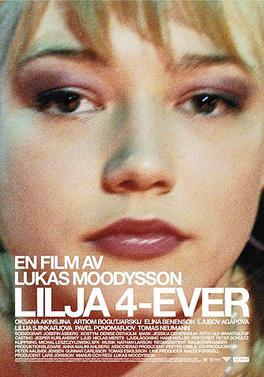
"Lilya 4-Ever"


Directed by Swede Lukas Moodysson, Lilya 4-Ever is a wrenching story of a girl who is sold into sex slavery.

In a post-Soviet Estonian slum, sixteen year old Lilya (Oksana Akinshina) is elated when she finds out her mother's new online boyfriend is taking both of them to the States. The day before the trip, Lilya finds out from her mother that she is not invited after all, and that she will be left alone with her battle-axe aunt Anna. Though her mother promises she will send for her, we know this is just the beginning for Lilya bleak existence. "Aunt Anna" steals her mother's flat away from Lilya and forced her to stay in disgusting closet where an old man had just died a week before. With no money, no food, and dwindling hope that her mother will ever send for her, she fends off apartment quad boys sniffing glue in her apartment and making advances, a battle-ax landlady who steals her mail and shuts off her electricity, and a mischievious little boy Volodya (Artyom Bogucharsky). Her friend persuades her to go to the city to prostitute herself, but Lilya does not participate. After she and Volodya become fast friends looking out for one another and helping each other within the apartment quad, Anna shuts Lilya out for good, her friends turn on her, and she is desperate, hungry, and cold. She is then forced to prostitute herself to survive. She is raped in her own apartment. She meets a young man, Andrei (Pavel Ponomaryov), who makes promises to about a better life in Sweden, but when she arrives, she is sold into sex slavery and kills herself.


Do something: http://www.globalfundforwomen.org/cms/hot-topics/trafficking/trafficking---grants--resources.html

Sunday, April 27, 2008

Trying to Find Helga Stromberg's Poetry

Helga Strömberg's Life (North Park University summary):

Helga Stromberg (nee Henning) was born March 14, 1886 in Gothenberg, Sweden. After graduating from secondary school in 1904, Helga attended a teachers college in Stockholm for a year. She then attended a nurses training school in Hamburg, Germany and in 1913 joined a Swedish Red Cross ambulance team serving in Serbia, where she was decorated. In 1914 she married a student of astronomy, Gustav B. Stromberg (MSS 22) in Paris, France.

In 1916 Gustav received a stipend from the Mt. Wilson observatory, and the two moved to Pasadena, California where they lived the rest of their lives. Helga started writing poetry in Pasadena under the nom de plum of Sister (or Syster) Benediction. She was published quite frequently in the Swedish-American press and the Pasadena Star. She also had six poem collection published, three in English and three in Swedish. She became an honorary member of the Eugene Field Society in 1940.

Helga's husband Gustav died in 1962, and Helga continued to live in the same house, 1383 North Marengo, until her death on July 7, 1971 at the age of 85.

Eddie Rabbitt's Cranium (I Love A Rainy Night II)

A collaboration by Larry Sawyer, Sara Farr, Lina ramona Vitkauskas, and Shawn Baker.


There isn't any kitchen in your dream
about the rusting eagle. Our mushroom Instamatic
moment browns the aperture. The mall trumpet
screeches into the plot with dialogue like:
"Por favor, my city slipped on a decent boa
of invisible psalms." Giant fantastic radio water,
unfortunate clocks, today's sloppy meat sprockets,
I say to you: NOUVEAU RICHE SUCKS.
Lightening tunnels to latex nuns and pumps.
Listen closely to the troupe playing
"Verily, Verily Asparagus." Uniform lips unclassed
by winnowing studies, lips reflecting fish inside
us all. Flagrant pooches drop like molten cereals;
and for only .99 cents, you are the happiest cactus
in the pool. Justify your jack-off petals with falling
sticks, your battery acid in rapture, your bottles pointed
toward your head with swarthy foam. All of a sudden,
I have to go to the bathroom because my hand is too cold.
Chicken.

"Lay down your head to be born"

We wrote these on Chinese New Year. I used fortune cookie slips from our meal to title each poem.

A collaboration with Gene Tanta, Mirela Ciupag, Larry Sawyer, and Lina ramona Vitkauskas.


That special someone loves to see the light in in your eyes.


Trees idealize this volatile bliss; in
the stink of farm and old peaches,
it is time to collect all the stray dogs,
these misconceptions a broth of your inner
countries. It's time to stop your damn pseudo--
and clean the sacrilege from the table...


He who has not tasted the bitter does not understand the sweet.


Lay down your head to be born, licked,
and dive in the water. Bleed the thimble,
take a gulp of jilted lovers, please speak
into destruction as clarity. Burn the women
first, then raze the local gentry, then pulverize
fuzz, howl, and whistle. The brine, my love, is an old hat.
My bulbous heart fired like pottery, wet like
a Mongolian horse, like a dripping film.


Keep your eyes open, and take advantage of the unexpected.


Here is a small horn.
When will we become ourselves?
The broccoli ground, a curse upon your rubber.
Sex is an addendum, your gesticulations
swirl to the bottom of my glass; it
is a revolt, cleaning the index finger.


Act with kindness. People return with good will to the place that has done them well.


The lettuce changes me.
I cringe in my blind cage.
What time does the dragon depart?
Limestone slams against conglomerate
like a banging door. What is wrong
about how rain comes? Stiff hands
like long watercress, mice in a tight pocket,
firecrackers. The sea is gauche,
the porch thinks you weigh too much,
yes, they were checked those pockets,
those poet pockets.

Tuesday, March 11, 2008

The Falling Baker

This neat blast from the past was brought to you by my impeccable memory of my 1970's/1980's childhood.